


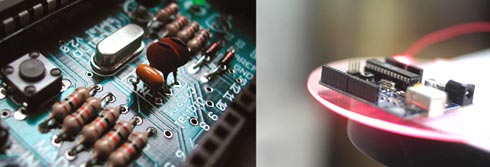
What is Arduino? Arduino is an open-source physical computing platform based on a simple i/o board, and a development environment for writing Arduino software. The Arduino programming language is an implementation of Wiring, itself built on Processing.
Arduino can be used to develop interactive objects, taking inputs from a variety of switches or sensors, and controlling a variety of lights, motors, and other outputs. Arduino projects can be stand-alone, or they can be communicate with software running on your computer (e.g. Flash, Processing, MaxMSP.) The boards can be assembled by hand or purchased preassembled; the open - source IDE can be downloaded for free. Arduino received an Honory Mention in the Digital Communities section of the 2006 Ars Electronica Prix.
Program
During the workshop, through some practical basic exercises, all the functionalities of Arduino board and software are explained. After that, all participants have to develop a small project to get confident with what they learnt. It's an "hands on" way to learnt.
The workshop is for all people that are courious to work with sensors without the need of a specific background knowledge.
Professor Massimo Banzi
Massimo Banzi teaches Physical Computing at Interaction Design Institue Ivrea. He has worked on interaction design projects for customers of the caliber of Prada, Artemide and Adidas. He is the founder of the Arduino project. Before working in Ivrea he was a software developer for many years. He is one of the pioneers of the commercial development of the world wide web in Italy, having been Italy’s first online webmaster. He has spent 4 years in London working at technological architectures for customers such as Labour Party BT, MCI WorldCom, SmithKlineBeecham, Storagetek, BSkyB and boo.com. He has also been Senior Technical architect for Sapient and CTO of the incubator for Seat Pagine Gialle/Matrix. Massimo has also taught at the MA in E - Business at Bergamo University. Massimo Banzi is an Id - lab partner and technology manager.